
Silicon Metal Project Description
1. Electric Arc Furnace Capacity and Production
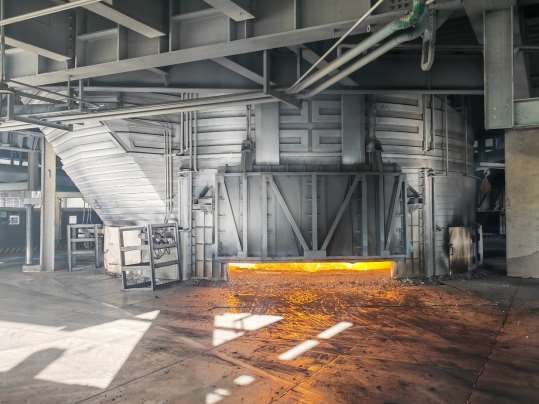
- 33,000 kVA semi-enclosed electric arc furnace, industrial silicon rotating furnace;
- Daily production of approximately 55 tons of silicon metal products.
2. Product proposal
|
Category |
Chemical composition, % |
|||
|
Si≥ |
Impurities ≤ |
|||
|
Nominal silicon content |
Fe |
Al |
Ca |
|
|
Si4110 |
99.40 |
0.40 |
0.10 |
0.10 |
|
Si4210 |
99.30 |
0.40 |
0.20 |
0.10 |
|
Si4410 |
99.10 |
0.40 |
0.40 |
0.10 |
|
Si5210 |
99.20 |
0.50 |
0.20 |
0.10 |
|
Si5530 |
98.70 |
0.50 |
0.50 |
0.30 |
3. Raw material conditions and technical requirements for public and auxiliary media

The production of metallurgical silicon primarily uses quartz as the main raw material, combined with low-ash coal, charcoal, or petroleum coke for charging into the furnace, with wood blocks used as auxiliary material. Charging refined materials into the furnace is an important measure to ensure smooth furnace operation, improve product quality, and reduce production costs. In accordance with the principles of charging refined materials, the technical requirements for the main raw materials are as follows:
3.1 Quartz
The chemical composition requirements of quartz are shown in Table 1.
Table 1-1 Chemical composition of quartz
|
SiO2 |
Fe2O3 |
Al2O3 |
CaO |
LOI (Loss on Ignition) |
H2O |
UD |
|
99.5% |
0.04% |
0.15% |
0.05% |
0.21 |
1% |
0.05 |
The size of quartz is 20~ 120 mm.
If there is soil in the quartz before batching, it must be washed with water to prevent soil and other attachments from entering the furnace and polluting the product. In addition, the properties of quartz should have strong thermal stability and antiknock rating is greater than 80%, to ensure the thermal strength after being fed into the furnace.
3.2 Reductant
The chemical composition requirements of reductants are shown in Table 1.
|
Name |
LAM Coal |
Green Pet coke |
Charcoal |
Prebaked Carbon Electrode |
|
FC |
54~60 |
88.00 |
75 |
95.00 |
|
Volatiles |
≥35 |
≥13 |
21 |
2.00 |
|
Ash |
≤3 |
≤0.5 |
4 |
3.00 |
|
S |
0.500 |
4 |
0.02 |
- |
|
P |
0.004 |
0.02 |
0. 045 |
|
|
H2O |
7.00 |
12.00 |
15 |
- |
|
Particle size, mm |
5~25 |
5~25 |
25~120 |
- |
3.3 Electrode
For this project, the electrodes of 33 MVA silicon metal electric arc furnace are selected as φ1272 mm electrodes, with a maximum allowable electrode diameter margin of 1320 mm reserved. The technical requirements for the electrodes are shown in the table below:
|
Resistivity |
Tensile strength |
Rupture strength |
Ash |
Volume density |
|
<25μΩ/m |
>2.5Mpa |
>5Mpa |
<1.5% |
1.56-1.61g/cm3 |
3.4 Oxygen and compressed air
Oxygen is mainly used in liquid silicon metal refining. The purity is more than 92% and the pressure is 0.6Mpa.
Compressed air is used for dust collector cleaning, furnace workshop purging, silicon ladle cleaning, pneumatic control, etc., at a pressure of 0.6 MPa.
3.5 Power source condition
Smelting power supply voltage for the submerged arc furnace: 30 / 35 / 66 / 110 kV
- Voltage: 11/10kV
- Frequency: 50Hz
- Low voltage AC400/230V
4. Project production capacity (33MVA)
|
No. |
Item |
Unit |
Single Furnace Index |
Remarks |
|
1 |
Capacity |
18000 |
Production at full load after compensation |
|
|
2 |
Compensated power factor of submerged arc furnace |
≥0.83 |
||
|
3 |
Smelting power consumption |
kWh/t |
≤12000 |
|
|
4 |
Annual working days |
Days |
330 |
|
|
5 |
Product output |
t/a |
~16500 |
Product yield: 92% |
|
6 |
Furnace capacity |
kVA |
33000 |
|
|
7 |
Capacity of single phase transformer |
kVA |
Each furnace 3×11000 |
3 single phase transformer |
|
8 |
Si recovery |
>82% |
||
|
9 |
Water circulation utilization rate |
>98% |
||
|
10 |
The emission concentration of main dust collector is equal to or less than |
mg/m³ |
≤10 |
Smelting process equipment
Introduction to process flow
Preparation of Raw Materials
The workshop is equipped with a complete raw material charging and distribution system. Screening, crushing, washing, and other raw material processing equipment are reasonably configured according to the condition of incoming raw materials.
All qualified raw materials are transported by truck or train to the raw material storage yard. After processing, they are conveyed to the batching station by grab cranes, belt conveyors, or loaders. At the batching station, the qualified raw materials are weighed and mixed according to specified proportions using a metering system. The blended materials are then delivered to the electric furnace for smelting.

Electric Furnace Smelting
The blended qualified materials pass through a surge bin, furnace-top belt conveyor, circular distribution car, and storage bin, and are then fed into the electric furnace through charging pipes for smelting and reduction. An auxiliary charging pipe outside the furnace is provided for manual burden surface maintenance under special operating conditions.
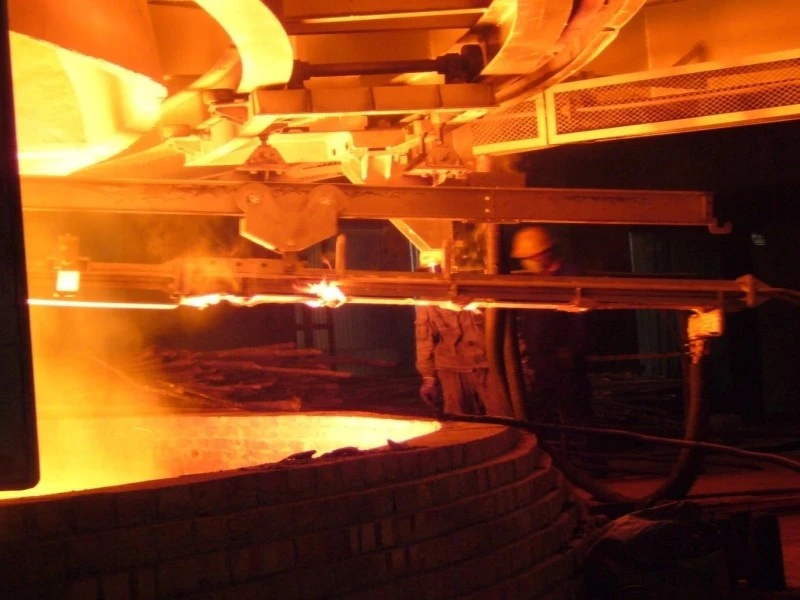
The mixed charge undergoes continuous electrothermal reduction inside the furnace. Molten silicon is continuously produced and accumulates at the furnace bottom. Silicon tapping operations are carried out at regular intervals. During tapping, the tap hole is opened using a burn-through machine, allowing the molten silicon to flow into a silicon ladle mounted on a ladle car. When the molten silicon in the ladle reaches a certain level, oxygen is injected for silicon refining.
Refining is performed by blowing oxygen-enriched gas into the ladle to reduce the aluminum and calcium contents. After refining, the molten silicon is transported to the casting area, where it is poured into ingot molds by an overhead crane or a tilting machine. The silicon metal ingot molds are mounted on movable carts, enabling fixed-point casting operations.
After cooling and demolding, the industrial silicon is transported to the finished-products bay for crushing, packaging, sampling, and laboratory analysis. The silicon ladles used for casting are cleaned, repaired, and baked after pouring, preparing them for the next tapping operation.
The furnace off-gas is purified by a dry baghouse dedusting system. The collected dust is densified, packaged, and stored, and can be sold to manufacturers as a raw material for the building materials, refractory materials, ceramics, and other industries.
The dust concentration in the purified exhaust gas is less than or equal to 10 mg/Nm³, meeting the local environmental regulations and atmospheric pollutant emission standards.
Silicon metal smelting process flow chart

More detailed solutions can be provided according to the specific requirements of the client.
Hot Tags: 33000kva submerged arc furnac, China 33000kva submerged arc furnac manufacturers, factory


